
Prolongation Cost Claims: The Comprehensive Guide to Establishing the Contractor's Entitlement
Prolongation Cost Claims: A Comprehensive Guide to Establishing the Contractor's Entitlement
Quick Answer: Prolongation costs represent the financial compensation a contractor is entitled to claim to cover additional expenses incurred by remaining on the project site longer than originally planned—specifically due to delays for which the owner (or engineer) bears full responsibility. Substantiating these costs requires conclusive evidence linking the delay event, the approved Extension of Time (EOT) period, and the actual additional costs incurred during that timeframe.
What are Prolongation Costs in Construction Contracts?
When a project is delayed due to reasons beyond the contractor's control, the contractor is compelled to maintain engineering staff, equipment, and site offices for a duration exceeding what was priced in the original tender. This ongoing daily financial drain is what is known as "prolongation costs."
Definition Box:
To understand prolongation costs from a professional standpoint, they must be categorized into three main components, as they are not all compensated in the same manner:
Site Overheads: Such as site engineers' salaries, rental costs for site offices and trailers, site security, and project-related electricity and water bills. (These are relatively easy to substantiate and claim).
Head Office Overheads: The proportionate share of the parent company's expenses (e.g., senior management salaries, corporate headquarters rent) that the project's revenue was intended to cover during the delay period. (These are difficult to substantiate and require complex accounting formulas). Price Escalation (Inflation): The increase in material and labor costs occurring during a delay caused by the Owner—costs the Contractor would not have incurred had the work been executed within the original timeframe.
The Fundamental Difference Between an Extension of Time (EOT) and Prolongation Costs
One of the most common misconceptions in the contracting sector is the belief that "time is always money." According to FIDIC standards and sound contractual practices:
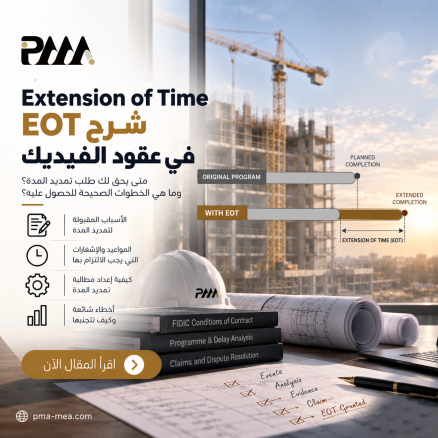
Extension of Time (EOT): Grants the Contractor additional time to avoid Liquidated Damages. It is awarded in cases of Owner-caused delays as well as instances of *force majeure* (e.g., exceptional weather conditions).
Prolongation Costs: Awarded only when the delay results from a specific breach by the Owner or the Engineer (e.g., delayed site handover, failure to pay progress payments, or delays in issuing designs). In cases of *force majeure*, the Contractor receives the time (EOT) but no financial compensation.
Practical Steps: How to Establish Your Financial Entitlement in Prolongation Claims
To submit a robust prolongation cost claim that meets contractual requirements, the contracting company’s contracts department must build the case file through the following steps:
Step One: Establishing Liability: First, one must cite a specific contractual clause entitling the Contractor to financial compensation and demonstrate that the disruptive event falls entirely within the Owner's responsibility.
Step Two: Establishing Compensable Delay: Submit an approved delay analysis demonstrating that the event impacted the project's critical path and specifying the exact number of days for which the Contractor is entitled to compensation. Step Three: Substantiating Actual Incurred Costs: Prolongation costs cannot be calculated via estimates or vague percentages. You must submit actual invoices, payroll records, and equipment rental receipts that specifically cover the approved "delay period."
Step Four: Excluding Ineligible Costs: The contractor must refine the claim to exclude expenses for labor or equipment redeployed to other projects during the stoppage period, as well as costs resulting from the contractor's own inefficiency.
Expert Note from PMA:
"The biggest pitfall contractors face when preparing a prolongation cost claim is using the 'Percentage Method'—based on the contract value—to calculate additional site overheads. Engineers and arbitration panels strongly reject this approach. Under FIDIC contracts, compensation is based on 'Actual Cost'—substantiated by precise financial documentation specific to the delay period—rather than theoretical mathematical averages."
Checklist: Essential Documents for a Prolongation Cost Claim File
Do not submit a financial compensation claim without attaching this package of contemporary records:
Certificate of Time Extension approved by the Engineer (if applicable).
Detailed payroll records for site staff covering the specific delay period (signed and stamped).
Invoices and rental receipts for permanent site equipment (e.g., tower cranes) during the delay period.
Utility consumption invoices (electricity, water, telecommunications) for the site during the same period.
Attendance logs and the Engineer’s daily reports to verify the presence of personnel on-site. The company’s audited accounts (if claiming head office administrative expenses).
Common mistakes leading to the rejection of immediate claims:
Claiming for loss of profit: Under most FIDIC clauses, in the event of a delay, the contractor is entitled to claim "Cost"—and sometimes "Cost Plus Profit," depending on the cause of the delay. However, claiming compensation for missed opportunities on other projects ("Loss of Opportunity") is extremely difficult and rarely accepted.
Double recovery: Claiming site management expenses as part of the cost of a "Variation Order," and then claiming them again as part of "Prolongation Costs" for the same period.
Frequently Asked Questions (FAQ) regarding prolongation costs.
Can mathematical formulas like the Hudson or Eichleay formulas be used to estimate expenses?
These standard formulas are primarily used to calculate "Head Office Overheads" only when actual costs are difficult to substantiate. However, arbitration tribunals require their application to be handled with extreme caution and subject to prior agreement; they are not accepted as a substitute for proving "Site Overheads," which must be substantiated by actual invoices.
What if there is "Concurrent Delay" involving both the owner and the contractor?
In cases of concurrent delay (where both the owner and the contractor cause delays affecting the critical path simultaneously), the prevailing contractual practice in the region is to grant the contractor an Extension of Time (EOT) to shield them from delay penalties, without awarding financial compensation (prolongation costs) for that period.
Is your project suffering from ongoing delays, and do you wish to secure your financial rights under the law and the contract?
Preparing financial prolongation claims requires a combination of engineering, contractual, and accounting expertise. At PMA, we prepare comprehensive claims based on factual evidence that withstands scrutiny.
[Contact our experts to review your project's case], or enhance your team's capabilities through the [Advanced Contractual Claims Management Program] at PMA Academy.